In this article
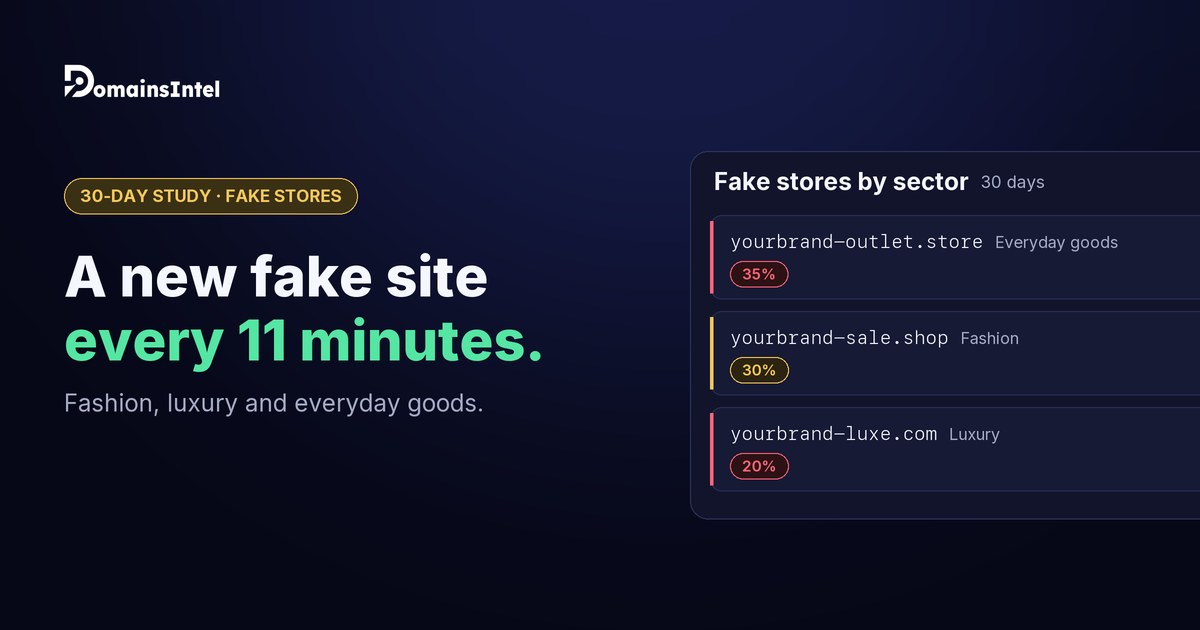
Over 30 days to 29 September 2026, DomainsIntel found a new fake site copying one of the brands it monitors every 11 minutes on average. 85% of them copied online shops in three sectors: everyday goods, from home and kitchen products to sports and outdoor gear (35%), apparel and fashion (30%) and luxury (20%). In 61% of the copied brands, it found more than one fake site.
What did DomainsIntel monitor?
Our platform monitors more than 20,000 brands. Each day, it checks newly registered domains and live websites for sites that copy a brand's name, logo, products or shop design, then reviews each suspicious site before it is treated as fake.
Its focus is fake stores: sites posing as a brand's online shop to take orders and payments. Phishing pages, social media accounts and marketplace listings are not counted here. The figures in this article cover 30 days, to 29 September 2026.
How often do fake stores appear?
Over the 30 days, about 3,900 fake sites appeared: one every 11 minutes on average.
Fake sites rarely come alone. Among the brands that were copied at least once:
- 61% had more than one fake site.
- 161 brands had 10 or more.
Over time, the numbers add up. In about a year of monitoring, DomainsIntel has recorded around 200,000 threats against the brands it watches, from lookalike domains to live fake stores. Not all of them are critical, but that is about 10 per brand on average: around 5 for a small brand, and up to 50 for a bigger one. It can escalate further: the largest case DomainsIntel has seen was a US retail brand copied by more than 150 fake stores.
Which sectors are copied most?
| Sector | Share of fake stores found |
|---|---|
| Everyday goods (home and kitchen, sports and outdoor…) | 35% |
| Apparel and fashion | 30% |
| Luxury | 20% |
| Other online shops | 15% |
Each sector attracts fake stores for different reasons.
Apparel and fashion: big catalogues, constant sales
Fashion shops publish large catalogues with clean product photos, sizes and prices. A copy can reuse all of it in a few hours. Frequent sales and "end of season" offers also make a 50% discount look normal to shoppers, so a fake clearance store does not raise suspicion.
ALOHA Collection, known for its splash-proof travel bags, saw how fast this happens. In its first month with DomainsIntel, 35 fake sites using its name were taken down. "New ones keep appearing, but their monitoring spots them fast and they're gone within a few days," says Becca Zak, Director of Digital at ALOHA Collection.
Luxury: high prices, strong demand for "deals"
Luxury goods sell at high prices, so even a fake store that claims 60% or 70% off can still take a large payment per order. Shoppers looking for a bargain on a designer bag or watch are the target. Many of these sites take the money and ship nothing, or ship a counterfeit.
Everyday goods: smaller brands, loyal customers
Brands selling home and kitchen products, sports and outdoor gear or other everyday items are often smaller companies with loyal customers who buy online. Fake stores copy them because these brands are less likely to have a team watching for fake sites, and their customers trust anything that looks like the brand's shop.
Sports Basement, a California sporting goods retailer, is one example. "Domainsintel team took down six offending domains in the first week of our subscription and now finds and takes down new ones as they appear," says Anthony Biolatto, CTO of Sports Basement. Read both testimonials on the DomainsIntel homepage.
Who runs these fake stores?
Most fake stores are run by organised groups, not by individuals. They choose brands for business reasons, not personal ones: good products, good photos, and prices high enough that "65% off" looks irresistible.
These groups work at scale. In 2024, security researchers at SRLabs exposed one network, run largely from China, that had used more than 75,000 domains for fake shops. It had taken orders worth an estimated $50 million from about 850,000 shoppers, mostly in Europe and the US. Most buyers received nothing, and the shops kept their card details.
The pattern is easy to spot once several copies appear. In one recent case, we found nine fake stores copying the same brand. All nine used the same shop template and similar discounts, and most were with the same hosting company, so they were almost certainly run by one group. That hosting company was Chinese-run, with its network registered in Georgia and its servers in the US: a mix of jurisdictions that makes such groups hard to pursue.
Identifying the people behind a fake store is harder still. Registration details are hidden or false, and unmasking the owners usually takes law enforcement.
What happens after a fake store is taken down?
The median time from detection to takedown was 2 to 4 days.
Once taken down, most fake stores stay down: only 2 to 5% of the sites DomainsIntel takes down come back online. The groups behind them can still open new stores on new domains, which is why monitoring continues after each takedown: finding the next copy quickly matters as much as removing the first one.
Why does this matter for your store?
Customers who buy from a fake store usually blame the real brand. In a 2026 survey by Clutch, 54% of consumers said they trust a brand less after a scam associated with it, even when the brand was not responsible. In a 2026 study by Forrester Consulting for Proximus Global, 68% of fraud victims stopped using or buying from the brand involved.
How can you protect your store?
- Search for your brand name with words like "sale", "outlet" or "discount". Fake stores often use them in their domain or page titles.
- Look at newly registered domains that contain your brand name. Most fake stores use a domain close to the real one.
- Ask your customer service team. Complaints about orders you have no record of are often the first sign of a fake store.
- Tell customers where your only store is. A short notice on your website and social channels, naming your real domain, costs nothing and helps shoppers spot a copy.
- Point affected customers to the right place. Shoppers in the US who paid a fake store can report it to the FBI's Internet Crime Complaint Center at ic3.gov.
In the long run, what works is making fake stores unprofitable: catching new ones as they appear and taking them down before they make money. When that happens consistently, these groups move on to easier targets.
We're doing this every day for the brands we monitor. To see the fake sites using your brand today, get a free report. For more detail, see the brand protection FAQ.
Frequently asked questions
Why are fashion and luxury brands copied so often?
Fashion shops publish large catalogues with clean product photos and run frequent sales, so a copy can reuse everything in a few hours and a 50% discount looks normal. Luxury goods sell at high prices, so even a fake store claiming 60% or 70% off can take a large payment per order. In DomainsIntel's 30-day study, apparel and fashion made up 30% of the fake stores found, and luxury 20%.
How many fake stores does a copied brand usually have?
Usually more than one. In DomainsIntel's 30-day study, 61% of the brands copied at least once had more than one fake site, and 161 brands had 10 or more. Over about a year of monitoring, DomainsIntel has recorded around 10 threats per brand on average, from lookalike domains to live fake stores.
How does DomainsIntel decide that a site is a fake store?
DomainsIntel checks newly registered domains and live websites every day for sites that copy a brand's name, logo, products or shop design, then reviews each suspicious site before treating it as fake. A fake store is a site that poses as the brand's online shop to take orders and payments.
Do fake stores come back after they are taken down?
Rarely. Only 2 to 5% of the sites DomainsIntel takes down come back online. The groups behind them can still open new stores on new domains, which is why DomainsIntel keeps monitoring after each takedown.