In this article
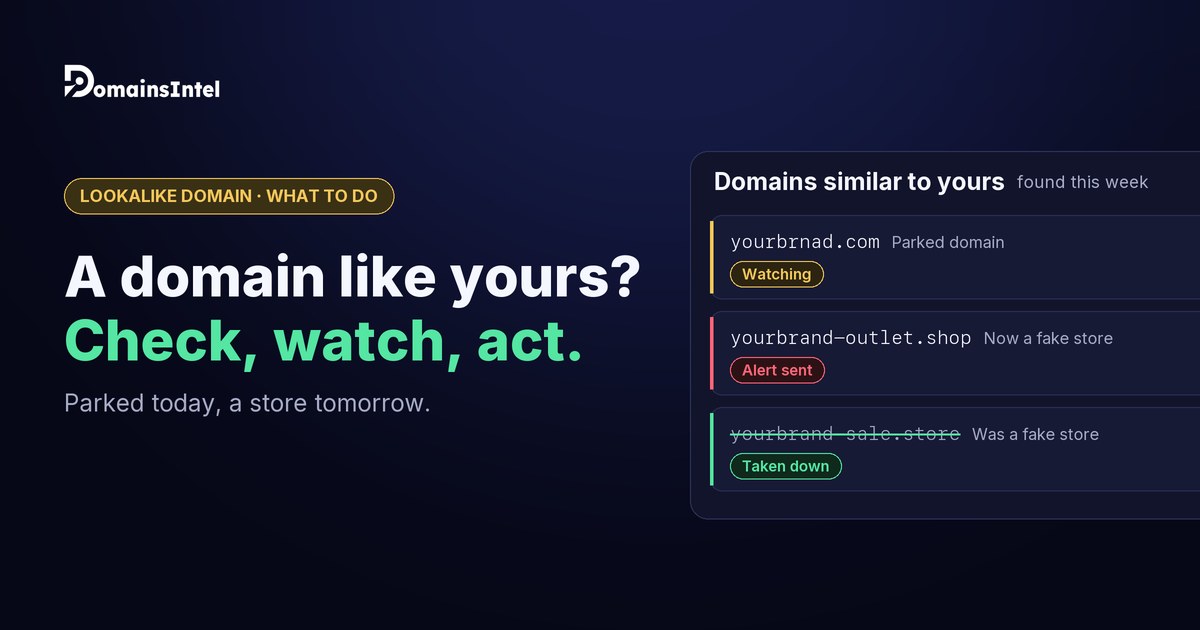
If someone has registered a domain similar to yours, check what it is doing before you act: most lookalike domains sit parked for weeks or months, and a parked domain can rarely be taken down. If it already shows a fake store, a phishing page or sends emails in your name, report it now; if it is parked, watch it and be ready to act the day it changes. DomainsIntel checks new domains for lookalikes of the brands it monitors every day, sends an alert when a parked domain becomes a live store, and takes it down.
This article is about domains that look like yours but don't (yet) copy your store. If the domain already shows a copy of your store, go straight to what to do in the first 24 hours.
Is a domain similar to yours always a threat?
No. Lookalike domains are registered for many reasons: a business with a similar name, a reseller, a domain investor hoping to sell it to you, or a squatter collecting parking ads. Some are registered by people who plan to open a fake store later and wait for the right season.
Before anything else, make sure it is not yours. Old agencies, former employees and past campaigns sometimes registered domains for a brand under their own account. Ask your team, and compare the registrar with the one you use.
What matters is not the name but what the domain does. A similar domain becomes a threat when it:
- shows a store selling your products, or products under your name;
- shows a login or payment page that imitates yours (phishing);
- sends emails that pretend to come from you;
- redirects your customers somewhere they did not mean to go.
What is the domain doing right now?
Four quick checks tell you which case you are in. They take a few minutes, and a private browser window is enough for a first look.
- Open it. A parked domain shows a page of ads, a "this domain is for sale" message or the registrar's default page. A store, a login form or a copy of your pages is a different case.
- See where it sends you. A domain that redirects to your own store may have been registered by someone in your company, or by someone collecting affiliate commissions on your traffic. A domain that redirects to another store or to an unrelated site is worth reporting.
- Look up the domain. ICANN's lookup tool shows the registrar, the creation date and the registrar's abuse contact. A domain created a few days ago with a name close to yours deserves more attention than one that has existed for ten years.
- Check for email records. Any DNS lookup tool shows whether the domain has MX records, which means it can receive email and is often set up to send it too. A lookalike domain with email records and no website can be used to write to your customers or suppliers as if it were you.
Write down what you find, with screenshots and the date. If the domain changes later, you will need to show what it looked like before.
Can you take down a similar domain now?
It depends on what it does.
Yes, if it is already a fake store or a phishing page. Hosts and registrars act on fraud: a site that impersonates your brand to take payments or steal logins breaks their rules, whatever its name. Collect the evidence and report it to the host, the registrar and the browsers, as described in our guide to taking down a fake website.
Yes, if it sends phishing emails. Keep the emails with their full headers and report them to the registrar's abuse contact and to the email provider shown in the MX records.
Usually not, if it is parked. A domain that only looks like yours and shows ads or a "for sale" page is not, on its own, abuse in the eyes of most hosts and registrars. They will usually answer that it is a trademark dispute and point you to the legal route. Reporting it anyway costs nothing, but don't count on it.
What can you do about a parked lookalike domain?
You have four options, and they are not exclusive.
Watch it
Most parked lookalike domains never become anything. The ones that do usually change fast: a store can be set up in an afternoon. Watching the domain means checking it regularly, or having it checked for you, so you see the change the day it happens and not when a customer writes to you.
Buy it
If the domain is for sale and the price is reasonable, buying it can be the cheapest way to end the problem. Make the offer through an escrow service or a domain broker, and if you can, without saying it is for your brand: the price tends to rise when the seller knows who is asking. Don't pay a high price for a domain that is only a typo among hundreds of possible ones.
File a UDRP complaint
The Uniform Domain-Name Dispute-Resolution Policy (UDRP) lets a trademark owner ask for a domain to be transferred or cancelled. You must show three things: the domain is identical or confusingly similar to your trademark, the owner has no right or legitimate interest in it, and it was registered and is being used in bad faith.
A parked domain can still lose a UDRP case, for example when it is clearly built on your brand and the owner offers to sell it to you. But bad faith is harder to show when the domain does nothing at all. Our takedown guide covers costs and timing in what to do if nobody takes the site down. For domains on newer extensions such as .shop or .store, the faster Uniform Rapid Suspension (URS) procedure can suspend the domain, though it does not transfer it to you.
A UDRP complaint needs a registered trademark. If you don't have one yet, that is the first step: every legal route relies on it.
Register your key variants first
You can't register every possible variant of your name, but you can register the ones that matter most before someone else does:
- your name on the extensions your customers know:
.com, your country's extension, and shop extensions such as.shopor.store; - the most obvious typos of your main domain;
- your name with the words fake stores use most:
yourbrand-outlet,yourbrand-sale,yourbrand-shop.
Register them under your company's account, not an employee's, with auto-renewal on. A domain you let expire is a domain someone else can register the next day.
How do you find domains similar to yours?
Thousands of new domains are registered every day, and lookalikes of your brand rarely announce themselves. The common patterns are:
- typos:
yourbrnad.com,yuorbrand.com, a missing or doubled letter; - added words:
yourbrand-outlet.com,yourbrand-sale.shop,yourbrandofficial.store; - other extensions:
yourbrand.shop,yourbrand.store,yourbrand.co; - swapped characters:
rnform,0foro,1forl, or letters from other alphabets that look the same.
To find them, you need to look at newly registered domains every day and match them against your brand name and its variants. Certificate transparency logs, which list the HTTPS certificates issued for new sites, help too: a lookalike domain that gets a certificate is often about to go live.
Doing this by hand works for one brand name and a few variants, once in a while. It does not catch a domain registered on a Friday night and turned into a store by Monday.
How to get an alert when a similar domain becomes a store
The moment that matters is the change: the day a parked lookalike domain starts showing your products and taking orders. Being alerted then, rather than weeks later, is the difference between a store that reached nobody and one that reached your customers.
DomainsIntel checks new domains for lookalikes of your brand every day and keeps watching the parked ones. When a parked domain turns into a live store, DomainsIntel sends you an alert, collects the evidence and takes the store down: see how a fake store takedown works. To see the domains similar to yours that already exist, get a free report.
Frequently asked questions
Can a parked domain similar to mine be taken down?
Usually not while it is only parked. Hosts and registrars act on fraud, and a domain that only looks like yours and shows ads or a “for sale” page is rarely treated as abuse. You can watch it, buy it or file a UDRP complaint. Once it shows a fake store or sends phishing emails, it can be reported and taken down.
How much does a UDRP complaint cost?
WIPO fees start at $1,500, before any lawyer's fees, and a decision usually takes about two months. A UDRP complaint needs a registered trademark, and bad faith is harder to show when the domain does nothing.
Will DomainsIntel alert me when a parked lookalike domain goes live?
Yes. DomainsIntel checks new domains for lookalikes of your brand every day and keeps watching the parked ones. When a parked domain turns into a live store, DomainsIntel sends you an alert, collects the evidence and takes the store down.
How do I find out who owns a domain similar to mine?
ICANN's lookup tool, at lookup.icann.org, shows the registrar, the creation date and the registrar's abuse contact for most domains. The owner's name and contact details are usually hidden or false, and identifying the people behind a domain usually takes law enforcement.